Wednesday, October 1, 2014

Summary of Progress on Sophomore Year


Hello all,

My junior year has already rolled into action, and I thought it would be a good idea to "round up" on what I've accomplished last year as a sophomore, generally summarizing details to put them into a much more organized manner.

I am working with Dr. John Moustakas, a professor a Siena College, NY on the topic of discovering new galaxies. Dr. Moustakas has been collaborating with a team known as CLASH (Cluster Lensing And Supernovae survey with Hubble) and has conducted extensive research on many galaxy clusters. His team just concluded research on Galaxy Cluster Abell 2744 and moved onto researching Galaxy Cluster MACSJ0416-2403.

Galaxy Cluster MACSJ0416-2403
Regarding progress of work from my sophomore year, I was able to analyze galaxy cluster Abell 2744, backed up by Dr. Moustaka's work. A lot of time was spent on understanding the background information regarding the Galaxy Cluster Abell 2744.

The Universe is believed to have been created about 13.7 billion years ago in an event called the Big-Bang. This is supported through the analysis of cosmic microwave background, thermal radiation left over from he Big Bang. Primordial atoms were created (hydrogen, helium) and they eventually clumped together forming stars. After that stars began to clump together to form the earliest galaxies. Eventually these early galaxies collided and merged with others to form the modern galaxies we know today (ie: Milky Way, M101, M64).

In order to understand our galaxies we know today, having a good understanding on the earliest galaxies is a must. These early galaxies are known as Lyman Break Galaxies (LBGs). Before we discuss (LBGs) we must understand the effect of redshift.

Redshift is the "stretching" of wavelengths, making them shift towards the red side of the electromagnetic spectrum. Redshift is caused by the constant expansion of the Universe. For example, an X-Ray stretching it's wavelength to visible light.
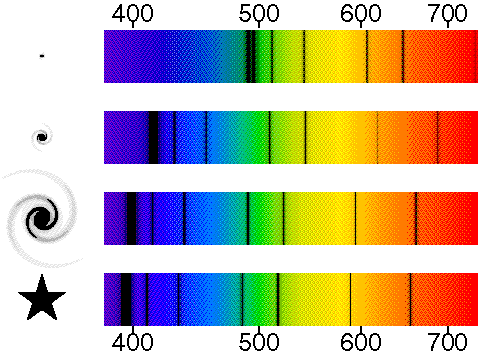
Notice how the spectrum shifts towards the red part of the spectrum the father the celestial object is from the viewer's location.


 Much of the light we see in space is in the visible part of the spectrum. However since space stretches 13.7 billion light years across (and counting) redshift causes visible light produced from the early galaxies to stretch from the visible part of the spectrum to the infrared part of the spectrum. This affects the early LBGs in great amounts. Because of the Universe's expansion, the redshift in the universe causes distant galaxies (12 billion years or older) to become invisible to visual-light observing instruments.


Another factor that affects LBGs (particularly in massive galaxy clusters) is gravitational lensing. Gravitational lensing is when the gravity that is between galaxies that make up the cluster becomes so strong, it causes light to bend. The light warps, magnifies, and duplicates the background light. Gravitational lensing allows Astronomers to look at light that would be almost impossible to see without the gravitational lens. This allows us to "cheat" and look at much earlier galaxies.

The streaks/smears of light is actually light produced from galaxies behind the Galaxy Cluster. 
Now, Lyman Break Galaxies are galaxies that are star-forming galaxies at high redshift. These galaxies are identified through a technique known as the Lyman-break technique. The Lyman Break technique is a technique used to observe a galaxies Lyman limit. The Lyman limit corresponds to the most energetic photons that can be emitted from hydrogen. The known Lyman limit is around 91 nm, this represents the energy required to remove an electron completely from a hydrogen atom, starting at the lowest energy level. The Lyman break technique is really helpful when it comes to determining the redshift of the galaxy, because it compares the observed wavelength to the emitted wavelength.

Here is the official formula for the wavelength based redshift equation:


For example,
A galaxy with a redshift of 7.2 would have it's wavelength observed at around 10,000 angstroms, due to the expansion of the universe. This causes wavelengths of light to be stretched towards the red end of the electromagnetic spectrum, hence the term "redshift" . However, technically it's real emitted wavelength would be around 1215 angstroms. This data is plugged into the equation to prove that the galaxy's wavelength is around 7.2.

Lyman break galaxies with a high redshift tend to not appear in the visual filter. This is due to the lightwavelengths  emitted from galaxies to be shifted into the infrared sectiopn of the electromagnetic spectrum. This is caused by the expansion of the universe. The Lyman break helps represent when the galaxy becomes observable, as the galaxy is observed under mulptiple filters based on designated wavelengths. For example, the Hubble Space telescope observes these Galaxy clusters under many different filters which range from wavelengths of 814 microns (visual) to 1600 (infrared).


More to Come!

Wednesday, June 4, 2014

Continuity of Work, and Gazing Towards the Future

On June 5th, at 7:00 pm at the Burnt Hills High School, I will be present at the symposium to present my poster based on the summary of my work so far. Many of my details come from other blog posts. Data collection from the SAOImage ds9 program as well as references from Dr. Moustakas's paper Young Galaxy Candidates in the Hubble Frontier Fields. I. Abell 2744.

I will be continuing my research on Lyman Break galaxies, studying the flux ratio, the brightness of each pixel in different filter (F814W all the way up to F160W), this will further our understanding of these mysterious distant high redshift galaxies. We can do this using a program known as SExtractor.

Hopefully I will be able to create Lyman Break Forests of the galaxy candidates in Abell 2744 as well as other galaxy clusters in the Hubble Frontier Fields Initiative.


Just recently, the Hubble Space Telescope Team unveiled a new image of the deep universe consisting of light from ultraviolet light all the way to near infrared light. this image consists of approximately 10,000 galaxies.

The farther you look back, the farther back in time you are.

Tuesday, May 6, 2014

Making Connections and Analyzing Lyman-Break Galaxies In the Universe

The Big Bang occurred around 13.6 billion years ago. This is supported through the analysis of cosmic microwave background, thermal radiation left over from the Big Bang. Thousands of years after the Big Bang, young stars formed and died, and eventually they grouped up together, forming the first young galaxies. The goal of my project is to discover the first galaxies to form in the 13.6 billion year old history of the Universe. Most of the data of my project is collected from the Hubble Frontier Field initiative, a current program that is analyzing galaxy clusters and their gravitational lensing. A gravitational lens is when gravity causes light to bend and warp. Due to the sheer gravitational force found within galaxy clusters, it causes light emitted from other galaxies to warp, bend, and magnify itself. This allows Hubble to "cheat" in a sort of way. Since the light from distant galaxies is too dim for Hubble and it's advanced instruments, gravitational lensing allows us to see these distant galaxies since the light is magnified. These distant galaxies are aged around 13 billions years or even older. 


Gravitational Lensing can be easily observed in Galaxy Cluster MACS J1206.2-0847. The streak-like figures of light can be easily visualized through the intense gravitational effects of the gravity within the Galaxy Cluster due to the immense amounts of dark matter.


We can select these galaxies through the use of filters and the Lyman Break Technique. Filters allow us to block and pass through levels of the electromagnetic spectrum. We use the photometric system called the Johnson-Morgan system, developed in 1953. This system uses a number of filters, U for ultra violet, B, for blue light, V, for visual light, G, for green, R for red, And I for infrared. Within the infrared filter, there are many sub categories, ranging from near infrared to far infrared. The galaxies I am analyzing can be found in the Y filter. Regarding galaxies being found in the Y filter, it means that the Lyman-Break occurs in the Y filter, or the galaxy is a Y "dropout". The Lyman-Break technique is a technique used to discover the age of the galaxy by analyzing the hydrogen atom. A Lyman-break is a term used to describe the action of a electron (on any energy level) ionizing and retreating to the first energy level. We can find the galaxies age by using the redshift equation ( Z + 1 = (Observed Lyman-Break/ Rest Frame)). A normal hydrogen Lyman break is found within the wavelengths of 912 Angstroms to 1215 Angstroms. However in space, due to the expansion of the universe, the Lyman break will be shifted towards the longer wavelengths of the electromagnetic spectrum. For example, a galaxy with a redshift of 7 will have it's Lyman-Break observed at around 10000 Angstroms rather than 1215. In other commonly used astronomical units, the observed Lyman Break would be at 1 micron rather than .1215 microns, or in nanometers; the observed Lyman-Break would be at 1000 nanometers rather than 121.5 nanometers. 

Lyman-Break Forests of YD4, YD9, ZD6, and ZD9

Equation used to find the redshift of Lyman-Break Galaxies


Now, for example, if the Lyman-Break would occur at 10000 angstroms, we would not be able to see the galaxy in the visible part of the spectrum, however, this galaxy (which is supposed to be seen in the visible part of the spectrum) is so far away, that it's emitted light is red shifted all the way into the near infrared section of the electromagnetic spectrum. In this project, I can visualize and see when the galaxy "pops" up.


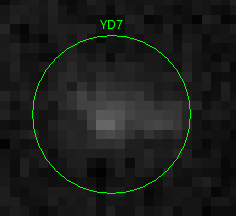
Lyman-Break Galaxy YD7 can be observed by comparing the area inside the designated YD7 Circle. Above, is the image of YD7 in a filter known as F814W, a filter allowing visible light in while it blocks out the infrared light. Below, is the image of YD7 in a filter known as F160W. This filter allows longer wavelengths, mostly infrared light in as well as some of the visible light spectrum. The whole point of comparing the images is that if YD7 was nearby, it's Lyman-Break would in the visible part of the spectrum. But it is missing from the visible filter. However we see it appear in the near infrared part of the spectrm. This is because of the expansion of the universe, it causes the Lyman-Break to be shifted towards the longer part of the spectrum.


Thursday, April 24, 2014

Abell 2744 and it's Y Dropout Galaxies Shown Through Different Filters

I am sorry I have not been updating my blog lately, I have been caught up with other tasks. However, I have been able to save a image of galaxy cluster Abell 2744 including it's distant galaxies. The reason that the distant galaxies are named YD is because the galaxies are so distant and dim, that the wavelengths we receive are literally dropping out of the Y passband on the\electromagnetic spectrum. This is because since the Universe is expanding, it causes the wavelengths to stretch along with the "fabric" of space. This causes the wavelengths we receive from these galaxies to become redshifted.
Galaxy Cluster Abell 2744 in the F160W filter 


Galaxy Cluster Abell 2744 in the F814 filter

One of the coolest things is that these distant galaxies are so distant, that they only appear in the near-infrared wavelength filter, or the F160W. This filter only allows wavelengths at 1.4 to 1.7 Microns to pass through. These wavelengths are found within the near infrared section of the electromagnetic spectrum. F814W however, is a filter allowing wavelengths of .7 to 1.0 Microns to pass through. These wavelengths are found within the optical section of the electromagnetic spectrum.

These distant galaxies are known as Lyman-break galaxies, or LBGs. Lyman-break galaxies are star-forming galaxies at high redshift (Abell 2744 has LBGs at 7 and greater). These galaxies are chosen through a technique called the Lyman-break technique. The Lyman-break technique is used by observing a galaxy's Lyman limit. This represents the energy required to remove an electron completely from a hydrogen atom, starting from it's lowest energy level. Since galaxies consist of a lot of stars, and stars consist mostly of hydrogen gas, it would be appropriate to study and observe the hydrogen atom (simply because there is an abundance of hydrogen in the universe). Because of the photons emitted from the stars within the galaxies, these photons can ionize neutral hydrogen atoms and will be absorbed by interstellar and/or intergalactic clouds of hydrogen. Any photon more energetic than the Lyman limit (912 - 1215 Angstroms) is most likely to be absorbed quickly by a hydrogen atom, because it can completely eject the only electron. This is represented by the sharp break.
Lyman Breaks (straight vertical lines)  can be seen around 1.0 Microns 
A regular galaxy will have it's Lyman break at the 912-1215 angstroms. However, a galaxy such as YD9 with a red shift of 8.1 would have it's Lyman break red shifted all the way into 1.0 Microns rather than having it around 912 - 1215 Angstroms. The only way to observe these galaxies are through observing them through different filters. The Lyman-break can literally be seen through shifting through the F814W and the F160W. This is so, because the wavelengths are so redshifted, no photons can be observed through the regular optical filters. Filters that allow the near infrared will allow the redshifted wavelengths to pass through. 
(Above) YD1 can be barely seen through the F160W filter
(Below) YD1 cannot be seen through the F814W filter. This is so because the Lyman Break is so redshifted, that it is in the near infrared part of the electromagnetic spectrum


(Above) YD9 is clearly shown in the F160W filter, while it is barely observable in the F814W filter (Below)


My biggest question as of right now, is how do Astronomers simply "pick" these distant Galaxies? Do they just know that these are good candidates for LBGs? Or is there much more of a process to finding these LBGs?

More soon!


Monday, March 24, 2014

Continuing to read papers, working on ds9, and much more!

I located distant galaxy candidates in Abell 2744, on the program SAOImage ds9. I found these objects by punching in data regarding the distant object's right ascension and declination. However, discovering these distant objects in the future will not be based on their right ascension and declination, but based on other information such as redshift. I do not have an image with the green circles and labels pointing out the location of these distant galaxies, but as soon as I do, I will be able to post them onto the blog. 

I am also reading papers, and I will be giving a summary about them in the future!

-Ben Schiher 
Gravitational lensing "copying" a distant quasar 

Wednesday, March 12, 2014

Hydrogen, the Element of the Universe

Hydrogen is the most abundant element in the universe. Stars use hydrogen their nuclear fusion process. Nebulae consists of large amounts of hydrogen that allow young stars to form.

Stars like the sun, produce energy through nuclear fusion, where hydrogen atoms are fused together to create products such as neutrons and helium

The Mystic Mountain in the Great Carina Nebulae (NGC 3372). This nebula is filled with hydrogen, just like the rest of the other nebulae.


The hydrogen atom consists of a proton and an electron which are bound together. The proton has a negative charge while the electron has a positive charge. Because they have different charges, the proton and electron constantly interact and stay with each other.

However, the electron can escape. If a electron escapes from the proton. the atom is ionized. In astronomy the former type of ionization is much more common. It is easy to visualize that the electron orbits the proton, most of use visualize a planet (electron) revolving around the sun (proton). However, the electron exists as a cloud orbiting around the nucleus. The density of this cloud is the strongest in the center, and it thins out.


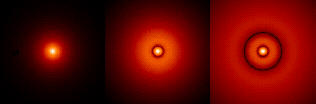
Hydrogen Orbitals
The brighter/denser areas is where the electron is most likely found orbiting

The amount of energy in a electron determines how far away the electron is from the proton. Electrons can only have a certain amount of energy for each orbital state. Each orbital state has a specific range of stored energy. The lowest energy an electron can have is called the ground state. The ground state is the closest orbital to the proton.  When the electron has higher energy than this lowest energy, it is excited, and It moves out, into the next orbital state (ie 1st, 2nd, 3rd Excited state orbital). 

These states of hydrogen are quantized. The electron in hydrogen can only have a certain amount of energy stored. These are called hydrogen's energy levels. The different energy levels are denoted by the quantum number n. For example, electrons with a high n (100) are weakly bound.

A hydrogen electron with a high energy level can be striped or ionized with energy called ionization energy. The energy levels are usually referred as being negative quantities. 

A hydrogen atom with excess energy is said to be excited. Two primary ways to excite an atom are through absorbing light and collisions. When two atoms collide energy is exchanged. Sometimes the energy is used to excite an electron from a lower energy level to a higher energy level.  The amount of collisions and how energetic their collisions are will depend on how tightly the hydrogen atoms are spaced and their average temperature.


....

This was a much more tougher lab than the others. This is so because I have not yet taken chemistry yet, but the Hydrogen Atom simulator really helped me visualize how energy such as Lyman, Balmer, and Paschen series of energy affected the hydrogen atom's electron. I learned that as the electron gets farther away from the proton, the less energy the electron can absorb. Much more energy levels can cause the electron to move or excite and ionize the electron. As I was conducting this lab, I had one major question, how do astronomers use energy levels to study such distant objects like galaxies? Another minor question was that what is the significance of the Lyman, Balmer, and Paschen series of energy, and what is their significance to astronomy?


Thursday, March 6, 2014

Redshift, Hubble's Law, and it's Relationship to the Expansion of the Universe

The Universe as-we-know-it is theorized to begin from the Big Bang, the idea that the universe began small and expanded. The Big Bang wasn't much of explosion, in fact it was the heating up and spread of matter.

The first evidence of the Big Bang came from Edwin Hubble. His observations included estimating the distances of the galaxies form our own. His observations on the light from the galaxies provided intriguing information. Hubble observed that absorption lines in the spectrum were almost always "shifted" to longer wavelengths the redder area of the spectrum. Hubble called it "redshift." 


The wavelengths tend to stretch as an object moves away from the observer. For example, a police car with it's sirens on will tend to change it's pitch as the car moves towards you and away from you. This is called Doppler shift.This is because the wavelengths of the sound changes as the waves come towards you and away. The waves coming towards you tends to be shorter in wavelength and the waves moving away from you have longer wavelengths.

Now, using galaxies, the Doppler shift works the same way. Galaxies (i.e The Andromeda Galaxy) coming towards us have wavelengths shorter than what they are originally supposed to be. Distant Galaxies on the other hand are moving away from us, causing their waves to be longer than originally measured. The wavelengths tend to stretch as an object moves away form the observer.


A galaxy coming towards us has a shorter wavelength than a galaxy receding. This is important for astronomers because it helps them understand how far away the galaxy is, and how fast it is receding/coming towards us.


Hubble measured the amount of the shift in the spectra from the galaxies. He was able to calculate the recession velocities of the galaxies. This measurement is known as Hubble's Law. Hubble's Law = The velocity at which a galaxy is moving away from us is proportional to the distance of that galaxy.

Hubble's Law: V= H x D


  • V: The velocity of recession
  • H: Hubble's constant
  • D: distance of galaxy
In order to be able to solve the law, data must be obtained. Hubble's constant is the result of comparing and observing the distance of many galaxies and compared the distances to the recession velocities of the galaxies. Hubble's constant is 22 km/s/mly


The distance of galaxies cannot be precisely measured, but astronomer have a good estimate of how far away the galaxies are. They use many methods, such as determining the parallax shift and the brightness of stars within galaxies. Parallax is the visual effect produced when nearby objects appear to shift position relative to more-distant objects. These indirect measurements of the distance of galaxies often fail when it is applied to distant galaxies. Distant Galaxies are observed by their intrinsic brightness, the amount of light actually emitted by the object.

A great picture, showing what astronomers use to discover the distance of celestial objects such as stars and galaxies

However, a much more accurate distance measurement can be made from the redshift of a galaxy. This is called the Velocity-Distance relation, and it makes it possible to infer the distance of an object from a measurement of its spectrum. The amount of the shift varies directly with the actual distance to the object. This is one of the reasons why redshift is so important.


The definition of redshift


After calculating the distance and Hubble's constant, a close estimate of the velocity of the recession of the galaxy can be made.

Hubble's law seems to imply that we are sitting at the center of the explosion, with everything moving away from us, but the expansion looks the same from any point in the universe. Hubble's law not only shows that the Universe is expanding, but we can also use the rate to determine how long this expansion has been occurring.

If we measure the distance between two galaxies and then divide the distance by the velocity of recession, then we can be able to determine how long it took for the the galaxies to reach their current distance.

For example, a galaxy 100 million light years (mly) away with a velocity of recession of 2,200 km/s would take 13.6 billion years to reach it's current distance.

Because more distant galaxies also move apart faster Hubble's law says any two galaxies reach their present separation in the same 13.6 billion years. This means that the Universe is around 14 billion years old.


This was a generally easy summary, and I did not have much questions on the expansion of the universe and redshift. I have done a lot of background reading on this topic before and this made sense to me. However I did have some questions. What is the Velocity-Distance Relation? The sources did not give much information about the exact relation. Another question was that how do astronomers really determine the time galaxies take to reach their current distance? I tried using the same format (100 mly / 2,200 km/s) and I did not end up with 13.6 billion years. I ended up with something more like .045 mly/km/s. I don't know if I am doing the math right, or if there is much more advanced math needed.